Pусский
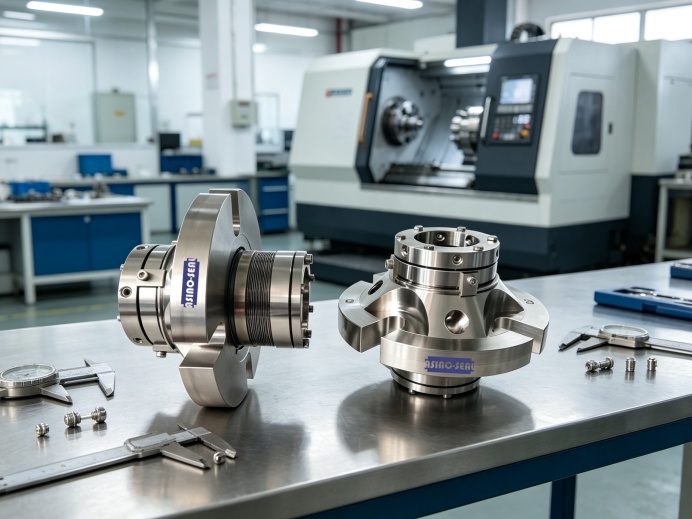
Double end mechanical seals have significant advantages over single end seals when dealing with media containing particles (such as slurries, sand containing crude oil, sewage) or easily polymerized media (such as styrene, acrylic esters, formaldehyde solutions).
The specific advantages are reflected in the following aspects:
The specific advantages are reflected in the following aspects:
1. Preventing particles from entering the sealing end face (key advantage)
Problem: In a single end face seal, the medium containing particles will directly enter the small gap between the moving ring and the stationary ring. Particles are like grinding paste, which quickly wears away soft rings such as carbon graphite, causing sealing surface failure and a sharp increase in leakage.
Double end solution: The double acting seal isolates the medium from the sealing end face through an external, clean isolation fluid system (such as API Plan 52 or 53).
The inner seal (on the medium side) is in contact with a clean isolation liquid, rather than a medium containing particles.
The outer seal (on the atmospheric side) also comes into contact with clean isolation liquid.
Even if there is a slight leakage of the isolation liquid, the clean liquid will still leak towards the medium side or the atmosphere side without wearing the sealing end face.
Problem: In a single end face seal, the medium containing particles will directly enter the small gap between the moving ring and the stationary ring. Particles are like grinding paste, which quickly wears away soft rings such as carbon graphite, causing sealing surface failure and a sharp increase in leakage.
Double end solution: The double acting seal isolates the medium from the sealing end face through an external, clean isolation fluid system (such as API Plan 52 or 53).
The inner seal (on the medium side) is in contact with a clean isolation liquid, rather than a medium containing particles.
The outer seal (on the atmospheric side) also comes into contact with clean isolation liquid.
Even if there is a slight leakage of the isolation liquid, the clean liquid will still leak towards the medium side or the atmosphere side without wearing the sealing end face.
2. Avoid the aggregation, coking, or crystallization of the medium between the sealing surfaces
Problem: Aggregated media (such as styrene and butadiene) are highly prone to polymerization at high temperatures generated by friction on the sealing end face, forming viscous gel like substances or solids. Single end sealing cannot effectively remove heat, and the polymer will stretch the sealing surface, leading to leakage.
Double end solution:
The isolation liquid of circulating cooling can continuously carry away the frictional heat of the sealing end face, and control the end face temperature below the polymerization temperature of the medium.
The isolation liquid is incompatible with the medium or an inert fluid, and will not trigger polymerization reactions.
Problem: Aggregated media (such as styrene and butadiene) are highly prone to polymerization at high temperatures generated by friction on the sealing end face, forming viscous gel like substances or solids. Single end sealing cannot effectively remove heat, and the polymer will stretch the sealing surface, leading to leakage.
Double end solution:
The isolation liquid of circulating cooling can continuously carry away the frictional heat of the sealing end face, and control the end face temperature below the polymerization temperature of the medium.
The isolation liquid is incompatible with the medium or an inert fluid, and will not trigger polymerization reactions.
3. Achieve "zero visible leakage" to the atmosphere
Problem: Leakage of particulate media can cause environmental pollution and block external pipelines; Media that are prone to aggregation may polymerize or become toxic when exposed to air.
Double end solution: The outer seal (atmospheric side) of the double acting seal is in contact with clean isolation fluid, rather than toxic, explosive, or foul smelling process media. Therefore, any leakage into the atmosphere is a clean isolation fluid (usually water, ethylene glycol, or low viscosity oil) that meets strict environmental and safety requirements.
Problem: Leakage of particulate media can cause environmental pollution and block external pipelines; Media that are prone to aggregation may polymerize or become toxic when exposed to air.
Double end solution: The outer seal (atmospheric side) of the double acting seal is in contact with clean isolation fluid, rather than toxic, explosive, or foul smelling process media. Therefore, any leakage into the atmosphere is a clean isolation fluid (usually water, ethylene glycol, or low viscosity oil) that meets strict environmental and safety requirements.
4. Extend service life and reduce maintenance
The dilemma of single end face sealing: When dealing with media containing particles or prone to polymerization, it may be necessary to replace the seal every few weeks or even days.
The effect of double acting seal: Due to the sealing end face always working in a clean and controlled isolation liquid environment, the wear rate is extremely low. In practical applications, the service life of double acting seal under similar working conditions can reach 5-10 times that of single end seals, significantly reducing maintenance costs and downtime.
In short, the core advantage of double acting seal in handling dirty, sticky, and heat sensitive media is that it changes the working environment of the seal from "harsh process media" to "mild and controllable isolation fluid", thereby greatly improving reliability and environmental friendliness. Although the initial investment is relatively high, in the long run, the losses caused by leaks and shutdowns often far exceed the price of the seal itself.
The dilemma of single end face sealing: When dealing with media containing particles or prone to polymerization, it may be necessary to replace the seal every few weeks or even days.
The effect of double acting seal: Due to the sealing end face always working in a clean and controlled isolation liquid environment, the wear rate is extremely low. In practical applications, the service life of double acting seal under similar working conditions can reach 5-10 times that of single end seals, significantly reducing maintenance costs and downtime.
In short, the core advantage of double acting seal in handling dirty, sticky, and heat sensitive media is that it changes the working environment of the seal from "harsh process media" to "mild and controllable isolation fluid", thereby greatly improving reliability and environmental friendliness. Although the initial investment is relatively high, in the long run, the losses caused by leaks and shutdowns often far exceed the price of the seal itself.