Pусский
1. Background
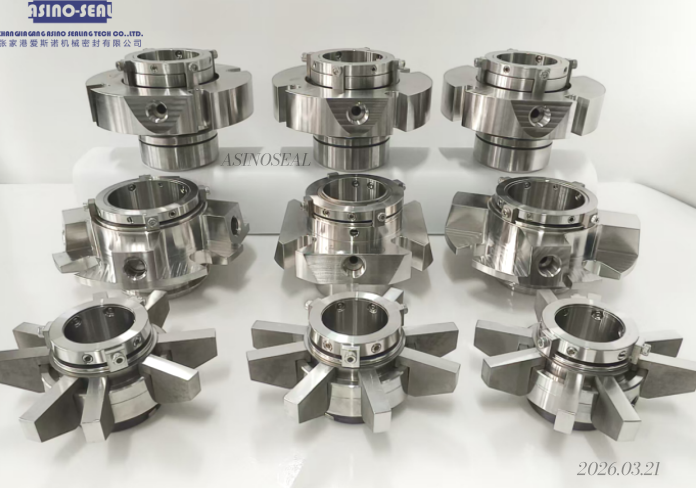
The types of double mechanical seal adopts a multi spring+back-to-back/series structure, which has redundant sealing capability and is widely used in toxic, flammable, explosive or particle containing media conditions. Its typical failure modes include: dry friction and thermal cracking of the end face, high-temperature aging of the O-ring, fatigue and loss of elasticity of the spring, and particle embedding wear.
2. Four strategies for extending lifespan
a. Structure and selection optimization
Prioritize the use of containerized+balanced design: reduce end face load, minimize heat generation, and enhance the stability of sealing ring adhesion;
Friction pair materials are classified and matched according to working conditions:
Medium side (high corrosion/abrasion) → pressureless sintered silicon carbide (SiC);
Atmospheric side (clean cooling water) → Hard alloy;
Corrosion prevention of elastic components: Multiple springs are prohibited for highly corrosive media (which are prone to corrosion), and Hastelloy corrugated pipes are used for compensation.
b. Accurate control of flushing and isolation system
The flushing plan determines the sealed "living environment" and must strictly match the working conditions
Additional explanation: If the pressure of the isolation fluid is lower than the chamber pressure, the second stage cannot withstand pressure after the first stage seal fails; If it is too high, accelerate the compression deformation of the O-ring. On site, pressure gauges and regulating valves need to be installed on the shaft seal water pipeline for real-time monitoring.
c. Key control points for installation and operation
Assembly accuracy: The shaft runout tolerance must meet the standard, and the interference fit between the static ring seat and the cover must ensure the O-ring seal but not overload;
Spring compression capacity: The compression capacity of types of double mechanical seal should be twice that of the single end face (8-12 mm). If it is too high, it will cause the PV value to exceed the standard and the spring to fatigue prematurely;
Eliminate dry friction: It is strictly prohibited to evacuate the pump for operation; Before starting, it is necessary to turn and fill the sealing chamber with isolation fluid;
Vibration and movement control: Install double nut locking shoulder to prevent axial movement of the mixing shaft from damaging the O-ring.
d. Maintenance and status management
Daily monitoring:
Abnormal auscultation noise (spring breakage/moving ring jamming);
Sudden increase in monitoring leakage (indicating aging of O-ring or failure of end face fitting);
Regular replacement:
Replace the auxiliary sealing ring periodically (recommended for fluororubber ≤ 12 months);
Spring detection for elastic attenuation (replace if the rebound force decreases by more than 15% after compression)
3. Conclusion/Suggestions
Extending the service life of types of double mechanical seal is essentially building a "sealing system engineering mindset": we cannot only focus on the sealing body, but also need to closed-loop control the flushing pressure, isolation liquid cleanliness, shaft vibration, temperature gradient, and operating habits.