Pусский

Mechanical seals used in fluid machinery have long been characterized by safe and reliable operation. However, occasionally there will be serious seal leakage and high maintenance costs due to changes in working conditions and structure, or installation problems. One of the reasons for this phenomenon is that it is often unclear how the mechanical seal chamber actually works, making it difficult to detect problems. Changes in operating parameters that have a direct impact on sealing performance will further complicate the problem. Unfortunately, mechanical seals are different from motors, bearings, gearboxes and other rotating machinery. They have to work in a changing environment affected by a variety of factors. These factors include: (1) flow changes caused by work needs; ( 2) Changes in net (suction) pressure head caused by fluctuations in suction pressure, changes in liquid level in the tower, or changes in temperature and pressure of the working liquid flow; (3) Changes in fluid properties caused by changes in work or atmospheric environment, or intermittent work ; (4) Changes in seal cooling conditions caused by nozzle erosion, heat exchanger failure, filter blockage or wear of the throttling support surface in the seal cavity; (5) Bearing wear or dynamic imbalance due to poor installation and adjustment Changes in mechanical vibration caused by changes in mechanical vibration; only in low-load applications, changes in conditions have little impact on seal life.
However, in some cases, changes in conditions may cause recurring or unpredictable seal failures. On important occasions, or when some unexplained failure occurs in the mechanical seal, it is important to analyze actual operating data to obtain answers.However, obtaining these data is often difficult or even impossible. In order to solve this problem, a mechanical seal status monitoring system (see the figure below) was developed, which can measure and record the sealing working environment and monitor the sealing status in real time. Sealing surface temperature: The temperature of the sealing surface during static or dynamic operation is monitored by a thermocouple installed on the stationary seat of the mechanical seal and 1.27mm away from the sealing surface of the mechanical seal. Static and dynamic pressure of the seal chamber: The dynamic and static pressure of the fluid in the seal chamber is measured by a pressure sensor. The pressure sensor is fixed with the sealing end plate through a threaded connection and forms a seal.
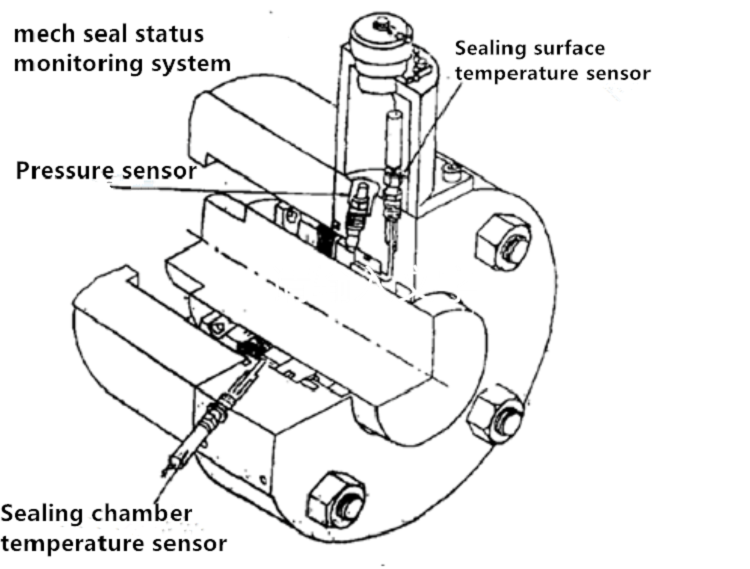
Each working environment that needs to be monitored has preset data sampling points or trigger limits. If the mechanical seal operates within specified parameters there will be no impact on sealing performance. When certain parameters exceed the specified range, the system records these parameters according to predetermined procedures. The system can record real-time data of sealing surface temperature, sealing cavity temperature and static pressure at any time. Data is read continuously for statistical purposes, but only average readings at predetermined intervals are recorded. In addition, dynamic pressure fluctuations are recorded when parameters exceed the pressure pulsation limit, or even if the pressure pulsation limit is not exceeded at certain special moments. Another characteristic of the dynamic pressure can be obtained through the analysis of the fast Fourier transform analysis program. The analysis results can be expressed as a pressure fluctuation spectrum, which in most cases can be used to find the cause of the pressure fluctuation. Once the system is installed and put into use, all sealing working status data can be collected and any changes in environmental factors that may affect sealing performance can be recorded. Therefore, the system can provide the entire process operation status of the mechanical seal, from which any factors that may cause the mechanical seal performance to deteriorate can be discovered.