Pусский
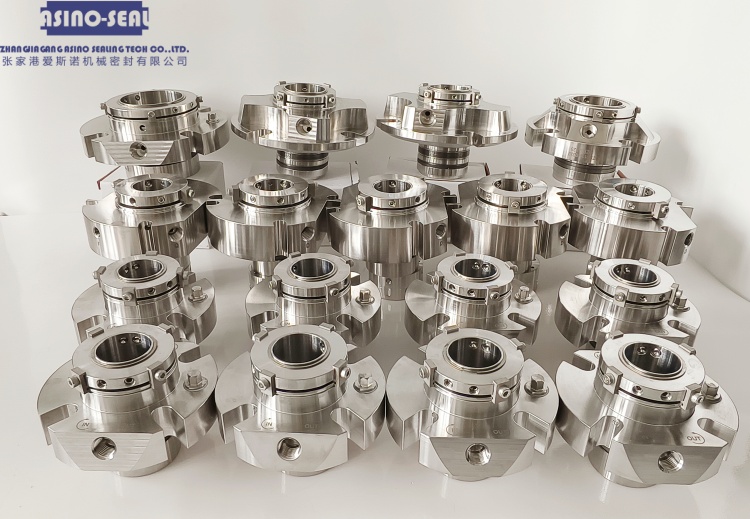
Single springs and ordinary springs usually refer to single springs (one large spring) and multiple springs (multiple small springs). Their differences in sealing are mainly reflected in the following aspects:
1. The uniformity of force distribution on the end face is different: due to the single point application of force, especially when the shaft diameter is large, large springs are prone to uneven pressure distribution on the sealing end face. Ordinary springs (multi springs) use multi-point distribution of force, which can provide very uniform end face pressure ratio, which is crucial for ensuring the sealing performance during long-term operation.
2. The ability to resist corrosion and blockage is different: in dirty media containing impurities, particles, or easy crystallization, large springs exhibit significant advantages. Its spring wire diameter is relatively thick, which is not easily trapped by impurities or corroded by corrosive media, and has strong resistance to blockage and corrosion. In contrast, ordinary springs have thinner wire diameters and higher requirements for medium cleanliness. Small gaps are easily blocked by particulate matter, and fine wires are more susceptible to corrosion and failure.
3. The stability during high-speed operation is different: when the equipment rotates at high speed, the large spring will be subjected to a large centrifugal force, which may cause the spring to shift or deform, thereby affecting the sealing effect. Ordinary springs, due to their small size and dispersed arrangement, are less affected by centrifugal force, making them more stable and reliable under high-speed conditions.
4. The applicable shaft diameter and space are different: a single spring seal has a simple structure and longer axial dimensions, usually only suitable for scenarios with smaller shaft diameters (generally recommended not to exceed 80-150mm). Ordinary springs can be flexibly arranged without being limited by the size of the shaft diameter, making them a common choice for sealing large shaft diameter equipment.
5. The compression amount (installation allowance) is different: In actual installation, the compression amount of single spring is usually reserved larger (such as compressing 3-5mm in a free state), while the compression amount of ordinary spring structures is relatively small (such as 1.5-2.5mm), reflecting their differences in elastic characteristics.
In summary, if the medium is dirty, prone to crystallization, or corrosive, a single spring seal is a more reliable choice; If it is a working condition with a large shaft diameter, high speed, and clean medium, ordinary springs (multiple springs) can provide better sealing uniformity and stability.