Pусский
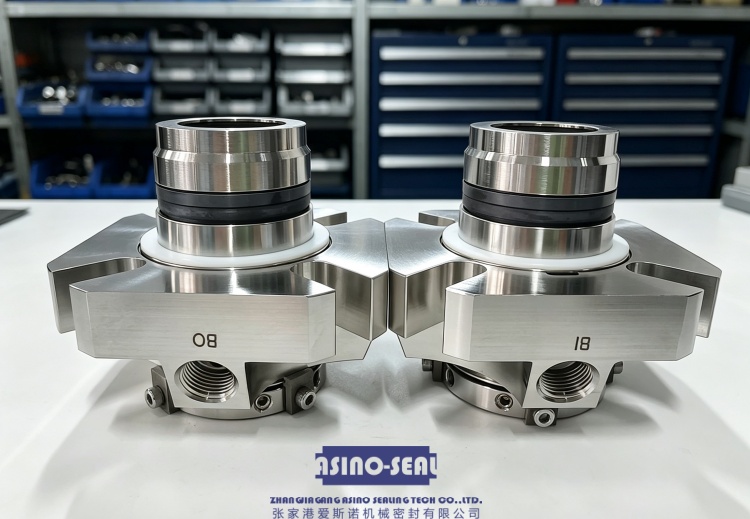
The double mech seal achieves engineering grade "zero leakage" effect of medium leakage through the core design of "dual end face seal+isolation liquid pressure barrier". The specific principle can be analyzed from three dimensions: structure, working mechanism, and abnormal protection:
1. Core structure: Physical foundation of dual protection
The double mech seal consists of two pairs of precision ground dynamic and static ring end faces (usually made of wear-resistant and corrosion-resistant materials such as silicon carbide/hard alloy), an isolation liquid system (supplied with buffer solutions such as mineral oil and ethylene glycol), and auxiliary seals (O-rings or bellows), forming a three-layer isolation system of "inner medium chamber isolation liquid chamber outer environment" structurally.
2. The core mechanism of zero leakage implementation
a. Double mech seal: the first line of defense against physical barriers
The moving ring rotates with the shaft, forming a tightly fitting friction pair with the stationary rings on both sides. Lubrication and sealing are achieved through a micrometer sized liquid film (thickness 1-3 μ m) between the end faces, physically blocking the path of medium leakage along the shaft.
b. Isolation fluid pressure barrier: the second line of defense for active protection
The isolation fluid system continuously injects buffer fluid into the cavity between the two sealed end faces, and its pressure is always 0.1~0.2MPa higher than the pressure of the inner medium (in accordance with API682 standard). Even if there is a small leakage on the inner dynamic ring static ring end face due to wear, impurities, etc., the isolation liquid will flow back into the sealing chamber to prevent the inner medium from leaking outward, achieving the core goal of "medium leakage prevention".
3. Dynamic balance and response to abnormal working conditions
During normal operation, the isolation fluid pressure and medium pressure are dynamically balanced to maintain the stability of the end face liquid film and reduce wear;
If the pressure of the inner medium suddenly rises (such as from 5MPa to 8MPa), the isolation liquid system will automatically adjust the pressure to avoid leakage caused by end face separation;
Auxiliary seals (such as bellows) can further prevent the isolation liquid from leaking axially, forming a closed-loop protection.