Pусский
Balanced and unbalanced mechanical seals are two common sealing forms in industrial equipment, mainly used to prevent fluid leakage when the rotating shaft passes through the equipment housing. This article will describe the difference between balanced and unbanlanced mechanical seal from structural design, stress characteristics, applicable working conditions, and performance.
1、 Basic Definition and Working Principle
Unbalanced mechanical seal:
The effective area of the sealing medium acting on the dynamic ring is greater than or equal to the contact area of the sealing end face, resulting in a significant increase in the specific pressure on the sealing end face as the pressure inside the cavity increases. This type of seal cannot balance the force of the medium pressure on the end face, so the end face load is relatively large.
Balanced mechanical seal:
By designing the structure, the effective area of the sealing medium acting on the dynamic ring is smaller than the contact area of the end face (i.e. load factor K<1), thereby partially or completely offsetting the influence of the medium pressure on the sealing end face, achieving pressure "unloading" and reducing the end face specific pressure.
2、 Main Differences Comparison Table
Unbalanced mechanical seal
Structural features: Simple structure, no pressure balancing mechanism
Force characteristics: The end face specific pressure increases linearly with the medium pressure, and the load is large
Load factor: K ≥ 1 (usually partially balanced)
Friction and wear: high friction, easy to generate heat, and fast wear
Applicable pressure range: generally suitable for low-pressure applications with sealing pressure ≤ 0.7 MPa
Application scenario: commonly used in low-pressure conditions such as centrifugal pumps, blowers, and mixing equipment
Balanced mechanical seal
Structural features: The structure is relatively complex and equipped with pressure balancing mechanisms (such as steps, grooves, etc.)
Force characteristics: The end face pressure increases slowly and is less affected by the medium pressure
Load factor: 0 ≤ K<1 (usually partially balanced)
Friction and Wear: Low friction, low temperature rise, longer lifespan
Applicable pressure range: can be used in high-pressure environments ranging from 0.7 to 4.0 MPa, even up to 10 MPa
Application scenario: Suitable for harsh working conditions such as high temperature, high pressure, and high speed, such as compressors, high-pressure pumps, etc
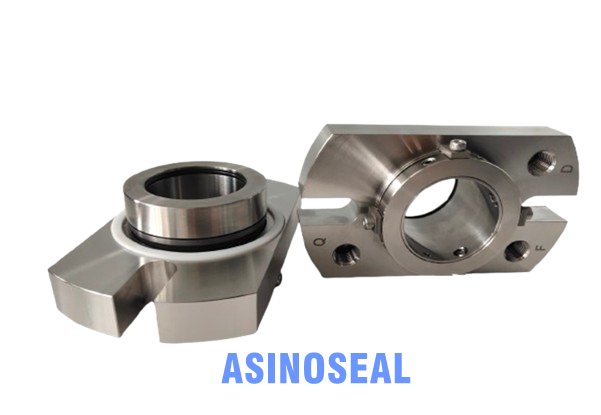
3、 Selection suggestions
When the medium pressure is low (<0.7 MPa) and the operating conditions are mild, non-equilibrium type is preferred due to its simple structure, low cost, and easy maintenance.
In situations with high pressure, high speed, or high requirements for sealing reliability, a balanced type should be chosen to reduce end face wear, improve sealing life, and safety.
In addition, for media with poor lubricity and low viscosity (such as liquefied gas), even if the pressure is not high, it is recommended to use balanced seals to improve lubrication conditions and heat dissipation performance.
4、 Summary
The balanced mechanical seal effectively reduces the specific pressure of the sealing end face through optimized structural design, improving stability and durability under high pressure and harsh working conditions; The non-equilibrium type, due to its simple structure, still has wide application value in low-voltage systems. In practical applications, the appropriate sealing type should be selected comprehensively based on the medium pressure, temperature, speed, and economy